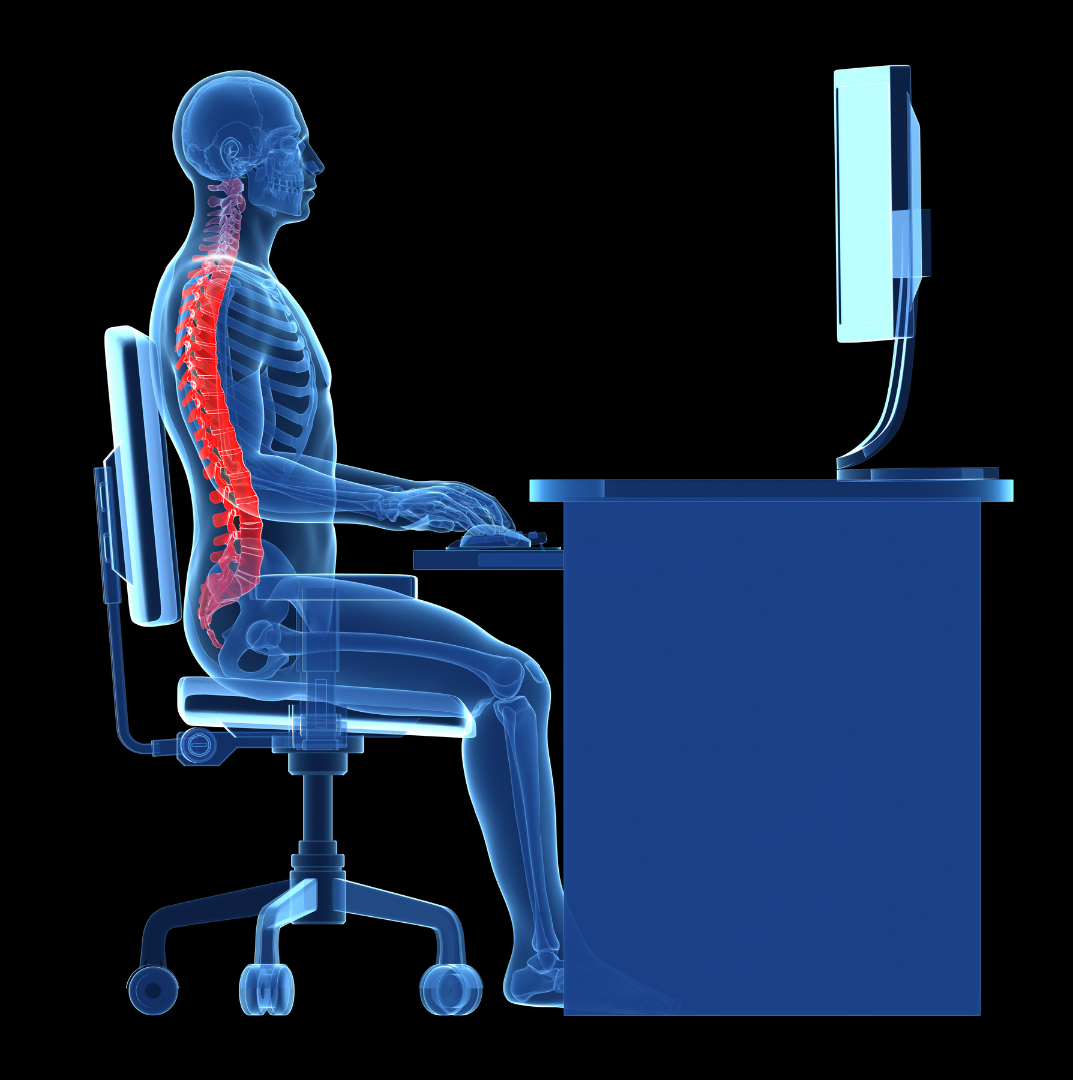
1How does sitting affect my posture?
So we hear we should stand more… but how bad is it? According to a study from the American Journal of Public Health (2018), when comparing those who sit more than eight hours a day compared to those that sit less than four hours a day, risk factors increase for type 2 diabetes, cardiovascular disease, cancers, depression and physical pain conditions. Let’s break some of these numbers down. There is nearly a 2X higher chance of type 2 diabetes, a 10-20% increase in cardiovascular disease conditions (strokes, heart attacks, etc.), there is between a 13-20% higher chance of dying from cancers, and up to a 20% increased risk of depression for those that sit more than eight hours a day compared to those sitting less than four hours a day
Luckily, the solutions is quite simple and is very effective! No matter how perfect your work set up is the most simple solution to fight against the terrifying statistics is just to get up and MOVE every hour!
2What are Ergonomics?
A simple description is the design of a workplace for the worker. Ergonomics can include using chairs for maintaining proper postures, placing water machines or printers in strategic areas across the room to increase step counts or simply placement of desk items like a calculator or a stapler that is used frequently. The challenge with ergonomics is that each worker and work environment is different and so there is never a one size fits all model that will work for everyone. This is why it is important to have the ergonomic environment assessed if possible or at least be able to alter it in a way that fits you and your work habits.
If you do not have access to an ergonomic assessment in your workplace that's ok! We have a resource to help you with altering your own environment to better fit your work needs! The assessment is completely FREE and will go through your desk set up and it will provide some easy fixes and alterations to best help you work optimally. At the end you will have a report for yourself to see all the changes as well! Lastly, we will have one of our practitioners follow up with your results and see if there are any other questions or concerns that we can help you with!
3When should I see a professional as a desk worker?
It’s never too early to seeking care if you are a desk worker!
Many individuals start experiencing aches and pains as a result of the prolonged sitting postures at the desk. It is incredible how your body learns to adapt to the postures that we spend extended periods of time in. Sometimes it is helpful but in the situation of desk work, it is not ideal.
In order to better enjoy and work optimally, it is beneficial to have aches, pains and discomforts resolved sooner rather than later. Removing these challenges can aid in keeping you moving, working out for stress relief, and generally improve the performance while you are working or just doing normal activities more comfortably.
4Why do people experience aches and pains with desk work?
The body's best trait is to adapt.
Your body adapts to the environment on a consistent basis in attempts to make your life easier. The body will identifies the position where your body is constantly and after 30 - 40 minutes in a position the brain is smart and figures that you want to keep spending more time in the current position. As a result, your brain will then start tightening muscles and creating scarring tissue to help make this current position more efficient and take less effort. Unfortunately, our lives do not revolve around staying in one position forever. So these adaptations are actually detrimental to our well-being and can often cause other problems to occur. There is more tension on the low back and hips, muscles and ligaments are under more strain, posture changes, and the neck and shoulders get tired of fighting gravity and you slowly drift closer and closer to your monitor.
All of these changes take place during a relatively short amount of time. Although aches and pains are common for desk workers, they are in fact not normal.
Pain is an indication that something is beyond what the body can handle and it is giving your a signal that assistance or change is required. It’s our job as to find out where the issue is coming from. At Baseline, in Vancouver, we have a team of amazing professionals who will be able to help you with your challenges. Our one stop shop includes Chiropractors, Physiotherapists, Registered Massage Therapists, and Kinesiologists who are trained to treat your current challenges, prevent future issues, and provide you with tools to help manage these symptoms outside of the office.
5What is the best desk posture back brace?
Would it be terrible to tell you there is none?
Those back braces and posture controls are only good temporarily at best. When back braces are constantly worn, these posture aids replace the muscles that are supposed to do the work and as a result those muscles get lazy and get weaker as they no longer have any use. The phrase “you use it or you lose it” really does come true when it comes to muscle activity. So if you are using a back brace or aid then use it only when required such as during heavy lifting or moments that are easy to create injury. Remember, your best posture is your next posture because that means you're moving!
6What are the benefits from treatment for desk workers?
● Relieve desk-related aches and pains
● Help improve your posture at the desk and in daily life
● Reduce headache frequency and intensity
● Reduce back pain
● Relieve tight muscles and joints and decrease pain
● Improve your focus at work
● Allow you to sleep better and relieve stress
● Prevent future injuries from happening
● Improve your mood and energy levels
● Empower you to take charge of your health and learning to listen to your body
● Support activities of daily living comfortably